
Executive Summary
John Ternus’ top priority is renewing Apple’s competitive advantage
Apple is near the end of its competitive advantage lifecycle (Build → Extend → Renew)
Apple has historically been an extraordinary renewer (Mac → iPod → iPhone → Services)
The renewal pipeline has become less clear going forward (AI? Health? Home?)
Innovation ≠ renewal; Apple doesn’t necessarily need a new breakthrough gadget
John Ternus Has One Job
Tomorrow morning, John Ternus begins his first day as CEO of Apple. He steps into simultaneously the most prestigious – and most challenging – role in the tech industry. That’s because Ternus takes over a company so spectacularly successful that its existing competitive advantage may be so good that it obscures the need to build the next one.
The foundation for thinking about this problem goes back to Michael Porter. Porter famously argued that a company can outperform competitors only by establishing a difference it can preserve. Durable Advantage Theory expands the logic one step further: for how long can that difference actually be preserved, and what can management do to extend that period?
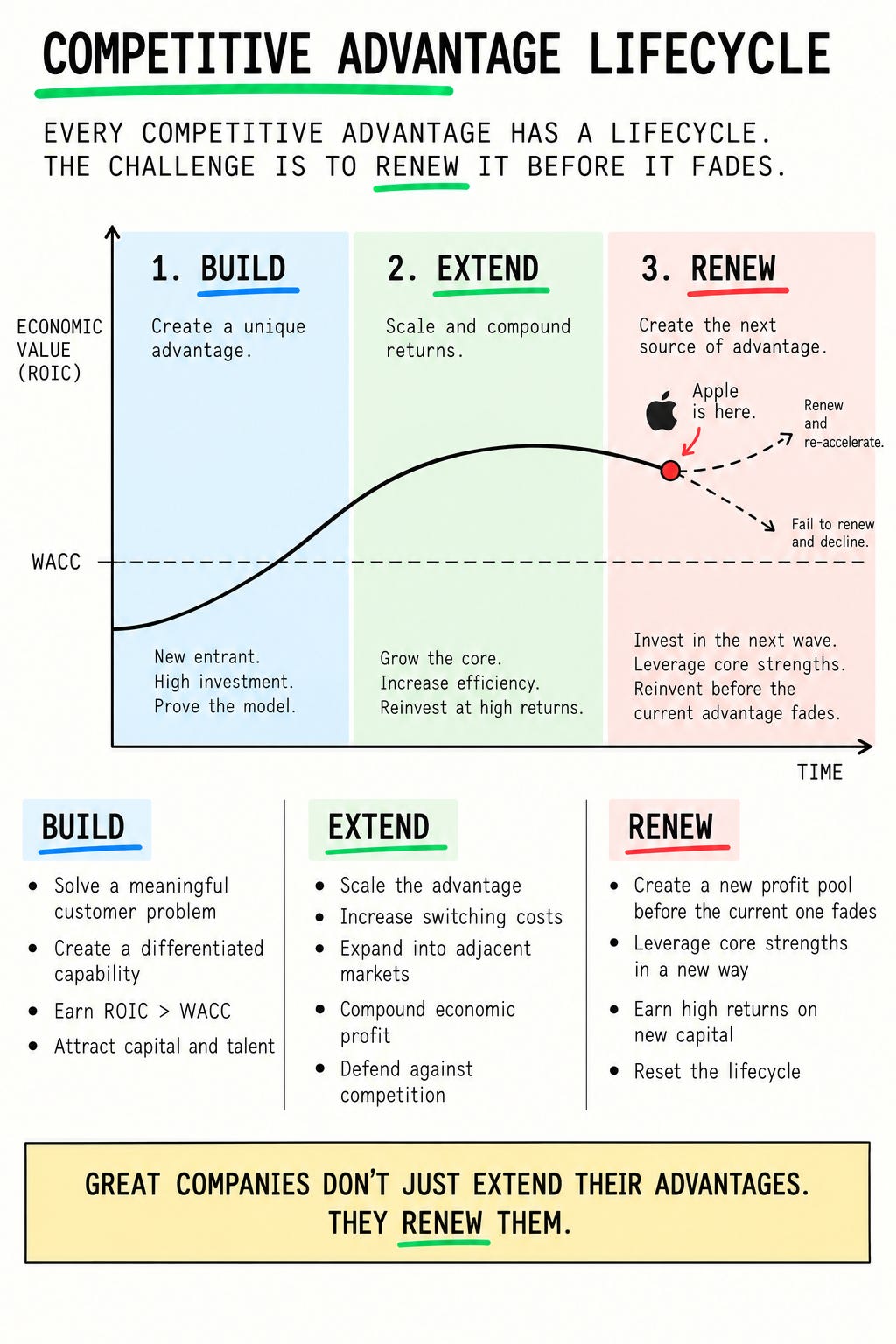
If we think of competitive advantage as a lifecycle, firms are continuously building advantages, extending advantages, and eventually renewing advantages. Apple is about as far to the right of that lifecycle as a successful company can get. I think most analysts intuitively sense this about Apple’s maturity, but Durable Advantage Theory quantifies it.
This isn’t entirely a new observation. Rita McGrath has spent years challenging the assumption that competitive advantages remain sustainable indefinitely. Her concept of transient competitive advantage argues that advantages increasingly move through lifecycles and that companies must continually move from one advantage to another rather than endlessly defending the existing one.
Where I depart from that literature is measurement. If competitive advantages have lifecycles, we should be able to observe where a company sits within one. And if management can affect that lifecycle, we should eventually be able to measure whether it is extending or shortening it.
That is the problem Durable Advantage Theory is attempting to quantify.
Renewing Competitive Advantage
Each stage of competitive advantage – build, extend, renew – is challenging in different ways, but renew may be the hardest, because it requires a company to repeat its success under a different set of conditions (new market, new customers, new competitors, etc).
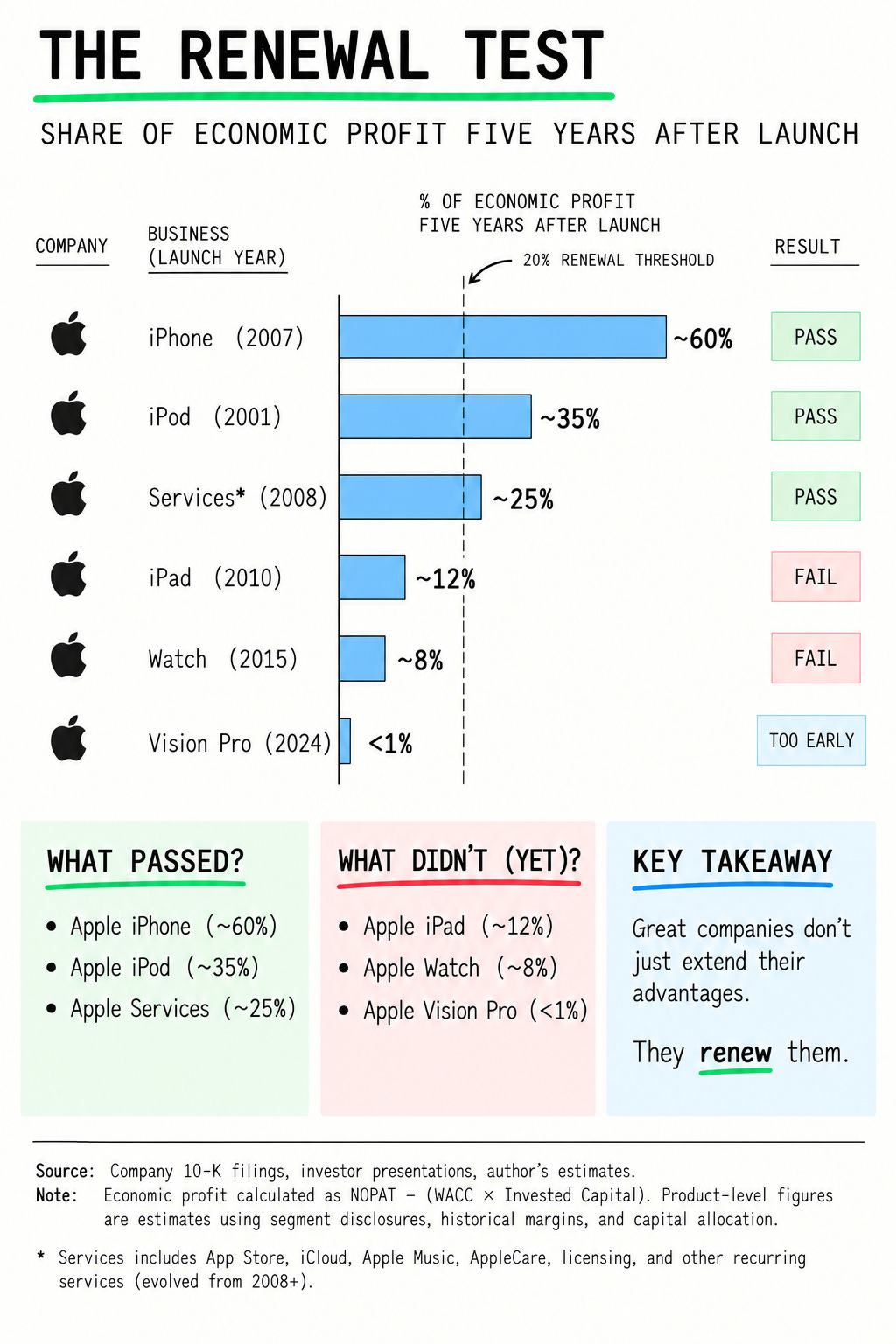
In my research, I’ve found that companies reach escape velocity during the renewal stage when a business that was economically immaterial five years earlier surpasses 20% of the company’s annual overall economic profit. That is intentionally a high bar. The business needs to become large and profitable enough to have a genuine durable advantage in its own right.
Apple has certainly continued launching things. Apple TV+ launched in 2019, Fitness+ in 2020, Vision Pro in 2024, and Apple Intelligence began rolling out in 2024. But none currently passes the test. TV+ and Fitness+ are already outside a strict five-year window; Vision Pro remains embedded within Apple’s Wearables, Home and Accessories reporting category rather than disclosed as a material standalone business; and Apple Intelligence is currently provided as part of Apple’s existing hardware/software ecosystem rather than reported as a new revenue or profit pool.
Services is the closest thing Apple has to a recent renewal engine – and it has been spectacular. Services revenue more than doubled from $53.8 billion in fiscal 2020 to $109.2 billion in fiscal 2025, an increase of 103%. Services gross profit grew even faster, from $35.5 billion to $82.3 billion.
But here’s the problem: Services was already a $54 billion business five years ago. It was already contributing 33.8% of Apple’s total gross profit in 2020. By 2025, that share had increased to 42.2% – impressive, but only an 8.4 percentage-point increase over five years.
And under my own definition, Services doesn’t qualify as renewal anyway. It wasn’t an immaterial business five years ago.
That leaves Apple in an unusual position. Its existing economic engine remains extraordinary, and Services has made that engine substantially more profitable. But looking only at businesses created within the past five years, there is not yet an observable new profit pool remotely comparable to the iPhone or Services. Is that sustainable?
Why Apple Has to Renew
Several other Big Tech companies have been able to compound the same fundamental competitive advantage for more than a decade without creating an entirely new profit engine. Meta continues to monetize the social graph through advertising. Alphabet continues to monetize search and intent through advertising. Netflix’s great renewal was its transition from DVDs to streaming; since then, its extraordinary growth has largely come from extending and scaling that same streaming advantage.
Apple is different. Its competitive advantage ultimately depends on convincing consumers, again and again, to buy its products and remain within its ecosystem. And unlike some of its Big Tech peers, Apple operates in a core market with enormous, well-capitalized competitors and credible substitutes. Apple accounts for less than one-third of global mobile-device usage, competing directly with Samsung, Xiaomi and a long tail of Android manufacturers.
That makes Apple’s historical performance all the more remarkable. But it also makes renewal unusually important. Apple cannot assume that today’s dominant device, interface or ecosystem will remain the center of consumer computing indefinitely. The iPod renewed the Mac-era Apple. The iPhone renewed the iPod-era Apple. Services helped renew the iPhone-era Apple. John Ternus’ challenge is to determine what renews the Apple of today.