
In an age of constant disruption, what survives?
That’s the question this newsletter will try to answer each week. I’ve spent my career studying disruption, but since becoming a parent I’ve become more interested in what endures. Each week I’ll explore one Fortune 500 company and measure whether its competitive advantage is durable or eroding.
How Long is Your Moat?
I’d rather own a business with a modest competitive advantage that lasts 50 years than one with an enormous advantage that lasts five.
That might sound obvious. But investors and management teams undermine that goal all the time. A recent PwC survey of more than 4,000 CEOs found that they spend three times more time thinking about issues in the current calendar year than five years out. The pressure of serving short-term shareholder interests is real. In another study, 78% of financial executives said they would prioritize smoother earnings in the short-term over creating long-term economic value.
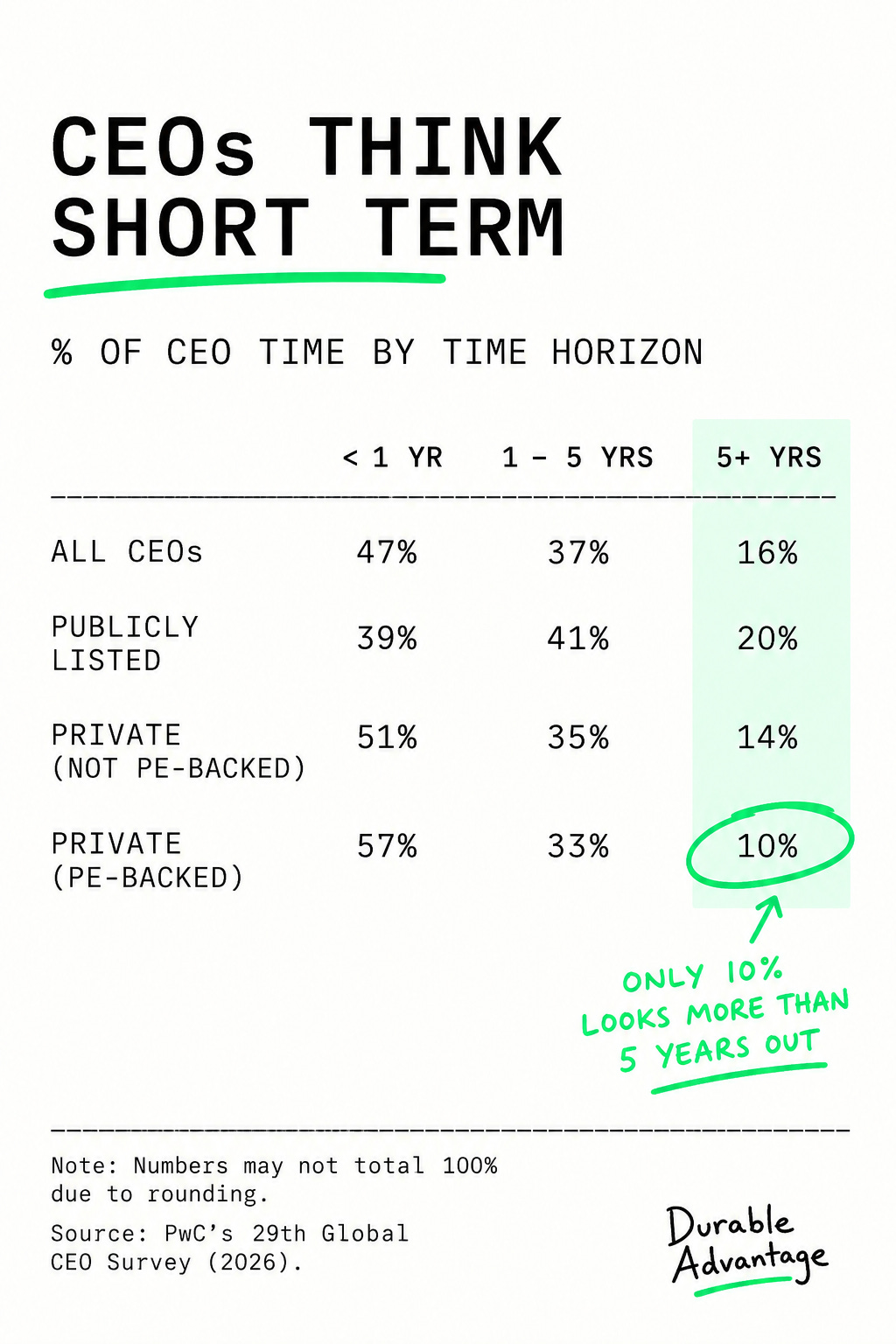
We are drawn to magnitude. Faster growth. Higher margins. Bigger market share. The next category killer. We are considerably worse at thinking about duration.
Finance has a name for this: the Competitive Advantage Period (CAP), which is the period during which a company can continue earning returns on invested capital above its cost of capital. Eventually competition is supposed to do what competition does: attract capital, copy what works, lower prices, and push excess returns toward zero. Morgan Stanley’s Michael Mauboussin calls CAP a “neglected value driver” because investors spend enormous amounts of time estimating growth and margins while paying comparatively little attention to how long those economics can survive. And survival may be getting harder.
The uncomfortable part is that long-duration competitive advantages appear to be getting more difficult to sustain. Globalization, automation, and AI, are all accelerating the cycle of industry disruption. I think we are all seeing and feeling this change first hand, and the academic literature supports it.
A moat isn’t something a company owns. It’s something a company has for a while. The most successful companies are those that have been able to renew competitive advantage. That’s a very different way to think about a moat. It is not one competitive advantage – it is a sequence of repeated competitive advantages. Thus, the challenge for management teams is to build the capability that enables them to realize repeated competitive advantages over and over again.
Apple doesn’t own consumer preference. Costco doesn’t own customer loyalty. Each has to keep earning those advantages as technology, competitors, and customers change.
Next week, we’ll look at Nike, and whether one of the most iconic brands of the last 50 years is renewing its competitive advantage or watching it erode.